How Weather in New Jersey Impacts Basement Waterproofing NJ Needs
New Jersey basements live under pressure, and not just the structural kind. The state’s weather patterns create a very specific set of challenges that shape how waterproofing should be designed, installed, and maintained. Homeowners often assume a wet basement is a simple rain problem. In practice, it is usually a combination of rainfall, snowmelt, groundwater behavior, clay-heavy soils, freeze-thaw cycles, coastal humidity, and the age of the home itself.
That combination matters because a waterproofing approach that works well in one region can underperform in another. A house in Monmouth County does not face the same moisture profile as a house in Morris County. A finished basement in a South Jersey neighborhood with a high water table behaves differently than an unfinished stone foundation in an older North Jersey town. When people talk about Basement Waterproofing NJ needs, the weather is the thread running through almost every recommendation.
A basement is below grade, which means it sits in direct https://www.google.com/maps?cid=15618896523686751270 contact with the surrounding soil. That soil absorbs water, expands, contracts, drains at different speeds, and transmits pressure to the foundation walls. Weather changes every part of that equation. The result is that waterproofing in New Jersey has to respond to more than occasional storms. It has to respond to a climate pattern.
Why New Jersey creates difficult basement conditions
New Jersey gets enough annual precipitation to keep foundation contractors busy, but totals alone do not tell the story. Timing matters just as much. A month of moderate rain rarely causes the same trouble as a weekend of hard downpours after the ground is already saturated. In many parts of the state, that is exactly what happens. You get periods of repeated rainfall, then a rapid snowmelt event, then a spring storm with nowhere for the water to go.
When soil around a foundation is saturated, hydrostatic pressure builds. That pressure pushes water against basement walls and under the slab. If there is any weakness, a wall crack, a cove joint gap, a porous masonry surface, or a deteriorated cold joint, water will find it. It does not need a dramatic opening. It only needs time and pressure.
Older homes are especially vulnerable because many were built before modern drainage membranes, robust footing drains, or reliable sump systems became standard. Even homes that had decent systems when they were built may now have drains clogged with silt, roots, or iron bacteria. In New Jersey, where housing stock spans many generations, that is a common field condition.
The weather also exposes workmanship issues that may have gone unnoticed for years. I have seen basements stay mostly dry through ordinary seasons and then suddenly take on water after one severe stretch of back-to-back storms. The homeowners often think something new broke. Sometimes that is true. Just as often, the existing system was marginal all along, and the weather finally tested it hard enough to reveal the weakness.
Heavy rain is the obvious threat, but not the only one
Rainfall is the most visible weather factor because homeowners can connect cause and effect. It rains on Tuesday, water appears in the basement on Wednesday. But the amount of rain is only part of the problem. Duration, intensity, and ground saturation make a bigger difference than people expect.
A fast two-inch rain on dry ground may cause fewer issues than a steady inch and a half after a wet week. Once the surrounding soil has little storage capacity left, runoff increases and groundwater can rise around the foundation. That is when seepage often appears at the wall-floor joint, around utility penetrations, or through hairline cracks.
Roof runoff can make the situation worse. In many New Jersey neighborhoods, homes sit on relatively tight lots. If gutters overflow or downspouts discharge too close to the house, a roof can dump hundreds of gallons of water near the foundation during a single storm. That concentration is more damaging than broad natural rainfall because it overwhelms the backfill zone right next to the wall.
This is why some homeowners are surprised to learn that their basement problem is not strictly a basement problem. The first fixes may happen outside, with grading corrections, downspout extensions, or drainage improvements. Basement Waterproofing NJ professionals who know the local weather understand that the solution often begins above ground.
Snow, ice, and the slow trouble of winter moisture
Winter creates a different pattern. Snow itself is not always the issue. The trouble comes when snow accumulates, compacts, and then melts quickly during a warm spell or a rain-on-snow event. That meltwater behaves differently than a summer thunderstorm. It can release over several days, keep the ground wet, and feed groundwater around the foundation for longer than homeowners realize.
Ice introduces another layer of risk. Freeze-thaw cycles open and stress small cracks in masonry and concrete. Water enters a tiny defect, freezes, expands, and leaves the crack slightly larger. One season may not produce visible damage. Several winters can turn a minor flaw into a chronic leak path.
This pattern is common in New Jersey because winter temperatures often hover around freezing rather than staying deeply cold for long periods. That repeated swing above and below 32 degrees is hard on foundation materials and exterior drainage surfaces. A concrete walkway that settles toward the house, a small separation where steps meet the foundation, or a cracked window well can become a direct water entry point once winter has done its work.
Homes with partially finished basements are often the hardest hit because the damage remains hidden. Behind drywall, insulation can trap moisture. Base trim swells. Metal studs rust at the bottom track. Homeowners notice a smell before they notice a puddle. By the time they pull back material, the source may have been active for months.
Spring is when a lot of basements fail their test
If one season exposes waterproofing weaknesses more than any other in New Jersey, it is spring. The ground is already carrying winter moisture, trees have not fully leafed out to take up water, and rainfall often increases. This is also when sump pumps get their hardest workout.
A sump pump is not a cure-all, but in many NJ homes it is an essential part of the waterproofing system. Spring tests whether the pump was sized correctly, whether the pit was installed at the right depth, whether the discharge line is clear, and whether the home has a backup plan during outages. Power failures often arrive during the same storms that make pumps most necessary. That is not bad luck. It is a predictable design concern.
I have seen homeowners invest in wall crack injections and interior sealants while ignoring an aging sump setup with no battery backup. Then a spring storm knocks out power for four hours and the basement takes on inches of water. The lesson is simple. Waterproofing is a system, not a patch.
Summer humidity creates damage even without leaks
A basement does not need standing water to have a moisture problem. New Jersey summers are humid, especially in central and coastal areas, and that humidity settles into cool below-grade spaces. When warm, moist air meets cooler basement surfaces, condensation forms on pipes, ductwork, walls, and even the slab.
This leads to a different kind of basement complaint. The homeowner says, “I don’t see leaks, but the basement smells musty and the air feels damp.” That is still a waterproofing conversation, because moisture control below grade is about liquid water and airborne moisture.
Condensation can mimic infiltration. Boxes get damp, flooring cups, and mold appears at the lower edges of walls. In some basements, a dehumidifier solves much of the problem. In others, humidity is only revealing a more complex issue, such as minor seepage combined with poor ventilation and organic building materials.
Summer also exposes whether a waterproofing contractor thought through the entire basement environment. A drainage system may keep liquid water off the floor, but if the space remains chronically humid, the basement is still not performing well. That matters more now because many New Jersey homeowners use basements as living space, home offices, gyms, and storage for valuable belongings.
Coastal weather changes the equation
South Jersey and shore-adjacent communities have their own set of moisture challenges. Higher groundwater levels, storm surge exposure in some areas, salt air, and prolonged humidity all affect basement performance. Even homes that are not directly in flood zones can deal with elevated subsurface moisture.
In these regions, the line between waterproofing and flood resilience gets thinner. A standard seepage-control approach may not be enough if the home is vulnerable to extreme weather events. Materials matter more. So does equipment placement. A finished basement with mechanical systems, electrical panels, or expensive flooring close to slab level carries greater risk near the coast.
Coastal storms also tend to be accompanied by wind-driven rain, which can push water into above-grade and near-grade openings. Basement problems sometimes begin with an exterior envelope problem higher up the house, then migrate downward. This is one reason an experienced local assessment matters. A wet basement is not always a below-grade defect alone.
Soil type decides how water behaves around the house
People often focus on what falls from the sky and ignore what happens after it reaches the ground. Soil is the middleman, and in New Jersey it varies significantly. Some areas have heavier clay content that drains poorly and holds water against the foundation. Other areas are sandier and drain faster but may allow rapid water movement toward lower sections of the structure.
Clay soils are especially troublesome because they swell when wet and shrink when dry. That expansion and contraction places stress on foundation walls and can worsen cracking over time. Water does not move through these soils quickly, so pressure can remain against the wall long after a storm passes.
Sandy soils reduce standing pressure in some cases, but they can still create issues if grading directs runoff toward the house or if the groundwater table rises. Fast drainage is not the same as safe drainage. Water that moves efficiently can still move straight toward a footing drain system that is undersized, collapsed, or blocked.
This is why two neighboring homes can behave differently in the same storm. Lot shape, fill history, retaining walls, patios, and even old landscaping changes affect subsurface flow. Basement Waterproofing NJ solutions work best when they are built around the site, not copied from the house next door.
What weather should change about the waterproofing plan
A proper waterproofing plan in New Jersey should account for year-round conditions, not just the last leak. That usually means looking at both water entry points and water management capacity. The goal is not to hope for drier weather. The goal is to create a system that handles bad weather without drama.
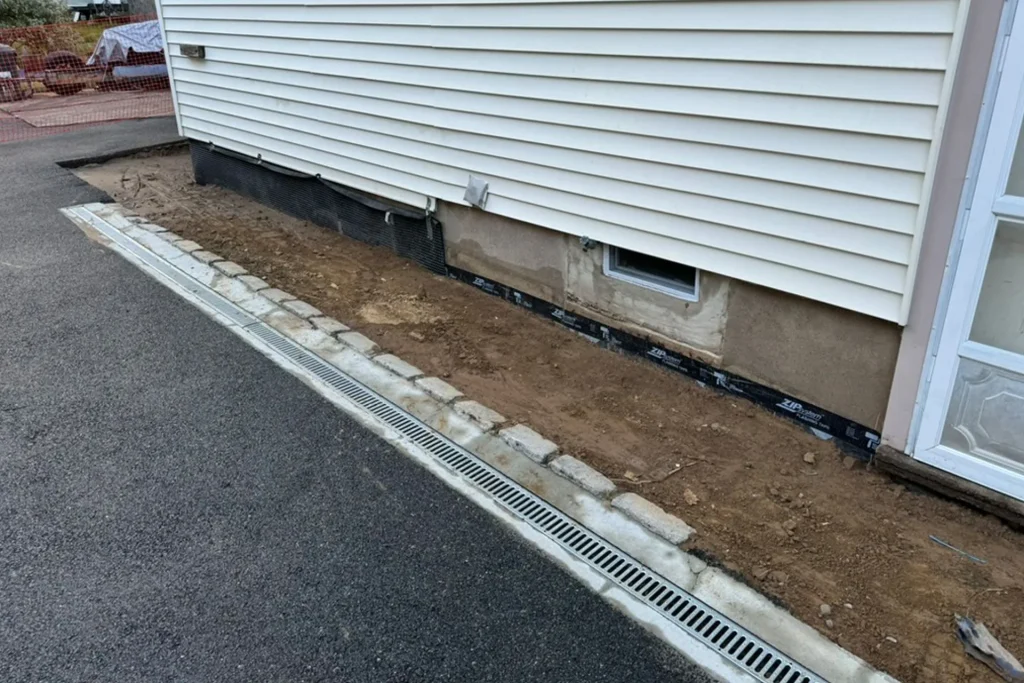
The most reliable strategies usually combine exterior water control with interior management. Exterior work may include grading, gutter improvements, downspout discharge corrections, trench drains in problem areas, or in some cases excavation and foundation membrane installation. Interior work may include perimeter drainage, sump pump systems, vapor control measures, crack repair, and humidity management.
There are times when one targeted repair is enough. A single non-structural crack in a poured concrete wall can often be sealed effectively. But in homes with recurring seepage across multiple seasons, piecemeal repairs tend to cost more over time. Repeated weather exposure keeps finding the next weak point.
A thoughtful contractor should also ask how the basement is used. An unfinished storage area can tolerate minor dampness far differently than a finished family room with engineered flooring and drywall. Risk tolerance changes the appropriate solution.
Warning signs homeowners in New Jersey should not ignore
Some basement problems announce themselves loudly. Others start quietly and become expensive because they were dismissed for too long. A musty odor after heavy rain, white mineral deposits on walls, rusting bottom corners of metal appliances, peeling paint, and slight warping of trim are all worth attention. None of them prove a major leak on their own, but together they often point to chronic moisture.
Keep an eye on timing. If dampness appears in late winter and spring, groundwater pressure may be the issue. If it spikes in summer, humidity and condensation may be carrying more of the load. If seepage shows up only during intense storms, runoff concentration or surface drainage may be the first thing to investigate.
These are the signs I would treat seriously:
- Water at the wall-floor joint after rain or snowmelt
- Persistent musty odor, even when no puddles are visible
- Efflorescence, which looks like a chalky white residue on masonry
- Repeated sump pump cycling during wet weather
- Cracks that appear to widen or return after prior patching
Any one of these can be manageable. Ignoring a combination of them is where damage accelerates.
Why quick fixes often fail in this climate
New Jersey weather is hard on cosmetic repairs. Waterproof paint, caulk, and basic patch products have their place, but they do not relieve hydrostatic pressure. If water is being pushed through a wall system from the outside, a surface coating on the inside is often temporary at best.
This is where homeowners get frustrated. They spend money, the basement looks fine for a season, and then the next wet cycle brings the same issue back. The repair did not necessarily fail because the product was defective. It failed because the diagnosis was incomplete.
A basement can take in water from several pathways at once. An old crack, a clogged footing drain, poor grading, and humid summer air can all contribute to “the basement problem.” Treating only the visible symptom rarely holds up through New Jersey’s changing seasons.
Choosing the right time for inspection and repair
Many people wait until the basement floods to call for help. That is understandable, but not ideal. The best time to inspect a basement is often after a moderate weather event when evidence is still visible but conditions are safe and manageable. Stains are fresh, damp zones can be mapped, and drainage behavior outside is easier to observe.
Repair timing also matters. Exterior work is usually easier to schedule during drier stretches, but diagnosis is often clearest during wet periods. Good contractors know how to connect what they see in one season to what is likely to happen in another.
For homeowners planning to finish a basement, the smart sequence is waterproof first, build later. I have seen too many attractive remodels undone because moisture control was treated as an afterthought. Once insulation, flooring, and trim cover the signs, small issues become expensive hidden ones.
A durable basement has to match the local climate
The phrase Basement Waterproofing NJ should mean more than a service category. It should imply a regional understanding of weather, soil, housing stock, and seasonal moisture behavior. A dry basement in New Jersey usually is not the result of one magic product. It is the result of matching the solution to the climate realities of the property.
That might mean stronger drainage capacity in a spring-flood-prone neighborhood. It might mean crack repair plus dehumidification in an older home with summer condensation. It might mean exterior grading and gutter redesign in a house where roof runoff is the real culprit. The details differ, but the principle stays the same. Weather drives the problem, so weather has to shape the fix.
Homeowners who understand that tend to make better decisions. They stop looking for universal answers and start asking better questions. Where is the water coming from, how does it change by season, and what system will still perform after the next hard rain, thaw, and humid spell? In New Jersey, those are the questions that lead to basements that stay dry for the right reasons.
ARD Waterproofing
Address: 98 Smull Ave, West Caldwell, NJ 07006
Phone number: +12016465936
FAQ About Basement Waterproofing NJ
What is the best waterproofing method for a basement?
The best overall approach to waterproofing a basement is a combined exterior and interior system that stops water at the foundation wall and safely manages any moisture that gets through.
What is the average cost to waterproof a basement?
The average cost to waterproof a basement ranges from $2,500 to $15,000, with most homeowners paying around $5,200 for a complete project.
Can a basement be waterproofed from the inside?
Yes, a basement can be waterproofed from the inside, and it is often the most affordable and least disruptive method.
Corrections
Spot something wrong? Send it to the desk and it gets fixed in the open.